A Short Biography of Terry Gilliam
Written by Phil StubbsTerry Gilliam, one of cinema's few uncompromising iconoclasts, has divided the critics throughout his career. He is regularly admired for his dynamic mise-en-scene, yet is often dismissed for his indulgences. Gilliam's trademarks are plentiful,.... he has a penchant for wide-angle lenses - these distort the faces of his characters in close-ups, but they also pack a huge amount of background detail into his shots. His scripts are full of personal themes - his love of history, his championing of the imagination, his dislike of bureaucracy, and his distrust of doctors and science... and there is a cage in every movie. There are in fact many autobiographical elements to be found in his films, and he often adds plenty of cheap gags into the mixture.
For a director whose reputation lies in his visual imagination, Gilliam has enticed a great number of top-notch performances from actors Oliver Reed, Michael Palin, Robert de Niro, Jeff Bridges, Robin Williams, Bruce Willis, Brad Pitt, Johnny Depp, and many others. Gilliam's own cinema hero is Fellini, whom he met in Rome while filming The Adventures of Baron Munchausen. Like Fellini, Gilliam is determined to stamp his own imagination and personal obsessions onto the silver screen.
Terrence Vance Gilliam was born in Minnesota on 22 November 1940. After eleven early years of a Huckleberry Finn/Tom Sawyer-type childhood (his description), his family moved to LA. There he was a witness to the Hollywood system, from the fringes. As a kid, his drawing and cartooning skills developed. After graduating from school where he apparently excelled at pole vaulting, Gilliam went to the Occidental College, studying Physics, which he later changed to Politics. In his last year at college, Gilliam sent copies of his college magazine work to comic maestro Harvey Kurtzman in New York.
Kurtzman was running a magazine called Help!, and was impressed. When writer Charles Alverson left the magazine, a vacancy arose, and Gilliam took a job there. He spent the next three years there - writing, designing and drawing - but being paid very little. During the time at Help!, he met John Cleese, who was roped in to star in a photo-story spoof - as a guilt-ridden man involved in an affair with a small doll. Gilliam's time at Help! terminated when national service loomed. He joined the National Guard for a few months, after which Gilliam did not return to Help!. Instead, he spent some time on welfare, and then decided to leave America temporarily. Gilliam spent six months touring Europe, hitchhiking and on motorbike. For part of the time, he worked as a cartoonist in Paris. Gilliam returned to America, and first went to New York, staying in Harvey Kurtzman's attic. He then moved back home in Los Angeles, and found a job in an advertising agency.
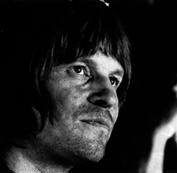
|
"I got it because I was
stylish", says Terry, "They hired me because of my hair. One day I
went to a girl's place and took with me a cover of Beatles for Sale and said,
'Come on, let's just do it. Pull it all down and cut bangs like The
Beatles.'" "This hairstyle had become a threat to the structure of the
entire society. America then had a real problem about conformity." Gilliam
was stopped by the police while driving a Hillman Minx. He was frisked,
"because they knew who I was - I was an out-of-work musician, living off
some middle-class man's daughter, peddling drugs." That Gilliam was
actually working in advertising, making twice the money of the policemen, did
not endear him to them. Whilst working at the advertising agency, Gilliam was
living with a British journalist Glenys Roberts, who recalls, "We had this
little glasshouse together in LA. He worked so hard for such little money. I
remember he did a cartoon strip for a surfing magazine, for nothing really, yet
he stayed up five nights running to finish it. We couldn't afford tables, so he
took all the doors off, laid them on bricks to make trestle tables. He walked up
and down all night working on storyboards for his strip. His enthusisam was
incredible. And his work rate amazing. I never personally liked his sense of
humour, but I could see his work was brilliant and original."
On their way
to a party, they encountered a demonstration against LBJ. It was peaceful, and
the protestors were giving flowers to the police there. "Suddenly police on
Harley Davidsons smashed into the crowds, and people started shouting, 'You
Bastards', and the whole crowd just went up. I remember being picked up by
my hair, being smashed to the ground and I was out for a moment. By the time I
got to my feet, there were bodies all over the place, shoes, handbags. The
police were rushing pell-mell after the crowd, hitting people in wheelchairs -
it was my first experience of hell on earth. I felt either I become a full time
activist or I get out of here and go back to Europe, be a cartoonist and do all
the things I'm much better at." Gilliam was fired from his job at the
advertising agency just before he was able to resign. His disenfranchisement
with the US led him to abandon his homeland and pursue life in England.
Later in
1967, Terry and Glenys moved to London, and got a flat together in Fulham. He
became art editor of a magazine called the Londoner, and Gilliam met many
like-minded writers and performers "It seemed impossible to get anywhere
with magazines", says Gilliam, " so I called John Cleese and asked him
how I could get into television. He suggested calling Humphrey Barclay, and
eventually, I got to him. He was only mildly interested by my written sketches,
but when I mentioned that I was a cartoonist he was interested. Somehow he found
room for one or two things I had written in Do Not Adjust Your Set" [a TV show
featuring Michael Palin, Terry Jones and Eric Idle]. On this show, a black and
white Gilliam animation about elephants was featured. At the time Gilliam became a
cartoonist for another show We Have Ways of Making You Laugh, featuring Frank
Muir.
|
Barry Took, a British producer and broadcaster, was at the time selecting
comedians for a new television show. It was at Eric Idle's urging that Gilliam
be included. That television show became Monty Python's Flying Circus, and
Gilliam became the resident cartoonist. Gilliam was responsible for the whole
visual style of the Python TV shows, and later either co-directed or designed
the Python films. "I knew the techniques of animation in theory, having
read a book or two, but I had never done anything in practice. The cutout
technique I had seen years earlier in New York. It was fast and crude. If I had
been given the money and time, I would probably tried to do a Walt Disney style.
I think I was good with sound effects and the timing. The noises are fifty
percent of the effect. I'd literally work day and night when we were doing a
series. The BBC had an excellent rostrum camera set-up. I'd be going seven days
a week, usually with two all-nighters, churning out artwork, then I'd go down
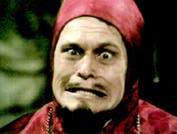
there to play with it under a camera." Gilliam can also occasionally be
seen as a performer, most notably as Cardinal Fang in the Spanish Inquisition
sketch (pictured). It was during the TV shows that Gilliam met his wife, Maggie
Weston, who was in charge of make up for the TV shows. Weston has subsequently
contributed to Gilliam's films.
 |
Gilliam then gained valuable movie experience with
the first Python film outings: And Now for Something Completely Different and
Monty Python and the Holy Grail - the latter he co-directed with Terry Jones.
This led to his first solo outing as director - Jabberwocky, a medieval fantasy
starring Michael Palin. Later, Gilliam contributed to the Python films The Life
of Brian and The Meaning of Life, but left Jones to direct on his own. In the
1980s, Gilliam created four hugely personal films: Time Bandits (1981), The
Crimson Permanent Assurance (1983), Brazil (1985) and The Adventures of Baron
Munchausen (1989). Gilliam created Time Bandits as a film all ages would enjoy.
In this he succeeded - his picaresque tale of six time-travelling thieves was a
hit across the States. He follows it with an outrageous short film The Crimson
Permanent Assurance, a live action cartoon - Gilliam in unadulterated form,
which documented the adventures of a band of piratical accountancy clerks. It is
a hugely enjoyable folly, which was to be featured in the middle of the film,
but was wisely moved to the start. This was Gilliam's contribution to the final
Python movie, Monty Python's The Meaning of Life. This is an uneven film, but
contains some of the best work that the Pythons ever did, including Every Sperm
is Sacred.
The success of Time Bandits gave him leverage to make his next film,
Brazil, about a dreaming clerk's hopeless battle against a totalitarian state.
Brazil was not a box-office smash, but is seen by many as his key work… a
dense script, fascinating themes, tremendous design and dark humour. That
America saw Brazil in Gilliam's intended form was thanks to his guerrilla
tactics against Universal head Sid Sheinberg, who wanted to distort Gilliam's
brave vision for financial reasons. Following the very public battle over
Brazil, Gilliam became perceived as a "difficult" director, but
because of the film's astonishing visuals, he still remained the director who
could deliver an expensive-looking film with a small budget. After Brazil was
completed, later in 1985 Gilliam helped by storyboarding the video for Kate Bush's single
Cloudbusting.
Terry's next project was the hugely underrated The Adventures of Baron
Munchausen. This film charts the adventures of an aged man who, through the
persistence of a young girl, Sally, rounds up his superhuman friends from a
variety of unlikely places in an attempt to save a town from both its
bureaucratic leader and a violent outside enemy. The making of Munchausen became
a nightmare, as its initial budget became woefully inadequate. A book which
followed the movie pointed the finger for its overspending at others; not
Gilliam.
After Munchausen, Gilliam worked for a few months developing Watchmen,
but that project came to nought. Many to this day still wonder what might have
resulted from that project. However, Gilliam soon found a script called The
Fisher King that had been sent to him from the States along with The Addams
Family, which he was supposed to be interested in… The Fisher King (1991) was
seen by Hollywood as Gilliam's first commercial film. He gained excellent
performances from Jeff Bridges, Robin Williams, Amanda Plummer and an
Oscar-winning Mercedes Ruehl, and eschewed complex effects. Millions adored the
movie, which charted the fall and subsequent redemption of a NYC talk show host.
Gilliam throughout remained loyal to LaGravenese's screenplay. After the release
of The Fisher King, Terry Gilliam's prospects looked much better. Gilliam said
just before the release of The Fisher King, "They love it in Hollywood and
the studio's behind it. I'm now a good guy. Until Munchausen, the storyline on
me was the director who can do any expensive-looking film cheaply. Then suddenly
I was the megalomaniac. Now I'm the director who can work with stars. It's all
madness!" The Fisher King was successful at the box office.
|
So for Gilliam, his
reputation now rebuilt thanks to The Fisher King, the offers came in, and he
began developing his next movie The Defective Detective, with Richard
LaGravenese. The theme is of a burned-out New York cop who ends up inside a
child's fantasy world. Not just any fantasy world, of course, but maybe more
original, outrageous and weird than anything previously seen on celluloid.
However, Gilliam entered "Development Hell". By the end of 1994,
Gilliam had still not got this project off the ground, since Paramount put the
project into "development", but refused to believe that Gilliam could
make it for $25m. Gilliam said he "begged, grovelled and humiliated"
himself, but to no avail. Gilliam was unable to get any of his projects off
the ground. At the time he said, "I'd like to get a couple more films done
before I die. The joke is that I did The Fisher King with an eye to suddenly
changing my rhythm and trying to make films quicker and more often. I thought
'Now I've proved to them that I can work in Hollywood, they trust me and we'll
be able to get another project off very quickly.' It hasn't worked out that way
at all."
While waiting for his
next project to take off, Gilliam kept busy. He presented a BBC documentary
called The Last Machine, which traced the very early pioneers of film. He was
involved with and publicised the CD-ROM Monty Python's Complete Waste of Time -
a game based around Gilliam's graphics and which featured sketches from the
Python TV shows. Also, he directed a TV ad for Nike. Gilliam toyed with many
other projects in the mid-90's, including A Tale of Two Cities and The Hunchback
of Notre Dame. Unable to get one of his own movie projects off the ground, he
decided to take on the project Twelve Monkeys, but it was not until 1996 that
that film was released. Starring Bruce Willis and Brad Pitt, it was a haunting
time travel melodrama that, like Fisher King, topped the box office charts on
its release. After 12 Monkeys, Gilliam again gave the Defective Detective script
a
reworking, but was snapped up to make Fear and Loathing in Las Vegas when Alex
Cox was removed from the project.
Gilliam attacked the script and upped the
budget, and made one of the ugliest films ever! "We want to apologise in
advance for whatever it is that we've done," smirked Gilliam as he
transferred the drug-induced book onto celluloid. Widely condemned (where it
wasn't ignored), it gave Gilliam an opportunity to chart an American era that he
had abandoned. Dangerous, nasty, yet hilarious, it was an important work.
Now approaching his sixties, he lives in a huge
old house near Highgate cemetery. He and Maggie have three children: Holly, Amy
and Harry. During the making of Twelve Monkeys, Gilliam, said "I really
have no concept of time, so that's probably one of the reasons I do these kind
of films; I'm trying to recreate another time and pretend to be in that period
for a brief moment. History has always been a great fascination for me. I think
that's why I live in Europe. You can't get away from history, it surrounds you
all the time. Whereas America has managed to banish history. One of the great
things about living here [in Europe] is that you're very much a part of a
continuum that you can't escape. I find it a wiser way to live." His taste
for movie-making remains undimmed. His next project is The Man Who Killed Don
Quixote, and starring Johnny Depp, Vanessa Paradis, Jean Rochefort and Rossy de
Palma, filmed in London and Spain. Expect it in 2001.